Thursday, March 31, 2016

Final Fantasy Quest - The Best Final Fantasy Game Ever Made (Legit, 100%)

Instead of finishing the repetitive Final Fantasy IV: The After Years or the farcical Final Fantasy V, I opted to play the superior Final Fantasy game. No, not VI, VII or even awkward-laughing X. I mean, of course, Final Fantasy Mystic Quest for the Super Nintendo Entertainment System.


Released in the US on October 5, 1992, Final Fantasy Mystic Quest was not at all given to us because the developers thought we sucked at JRPGs and need a basic game to train with. Rather, it is the true pinnacle which all true Final Fantasies strive for.

Mah boi!
It is the epic tale of Benjamin (most likely an orphan) and his quest to save the four elemental crystals. Like any Final Fantasy protagonist is wont to do. To cut out the fussiness of managing 5 players at a time, the player is given no more than 2 characters to control at any time. And unlike a certain other game, the game is not automatically over if the main character gets KO'd!

Ahem.

In all seriousness, FFMQ is at best decent, and at worst mediocre. The preceding year saw the release of Final Fantasy IV with its epic scope and (relative to a lot of other games at the time) intricate plot of friendship, betrayal and battle. Enemies didn't wait for your turn and bosses were tough. Surely the next game in the series would kick everything up to an 11? (Or, at least, a V).

Enter Mystic Quest. Few would consider this a worthy follow up to IV, or any entry in the series, for that matter. Gameplay was oversimplified and almost nothing like that of the "superior" entries in the series. To my knowledge, there hasn't been a remake of it like the other games.

And yet.

Perhaps time has afforded a more balanced perspective. Mystic Quest, despite not being the amazing V, is still worth considering. For instance, you can jump. There's tools that affect the world map, like a claw-shot or axe. Partners can either be automatic or controlled manually. While I won't apologize for the game's deficiencies, it's unfair to vilify the game merely because it's not IV or V.

What were the things I liked? One notable example is the Focus Tower. The game has no over world in the traditional sense, but the Focus Tower serves as a hub for the different areas to which Benjamin goes. Inside, there are several doors. These doors are unlocked as the game progresses. I admit, it was fun to wonder where each door would lead, and then finally unlock it.

One of the first doors seen, but the last unlocked
Another cool feature are the battle sprites of the enemies. Even in the glorious oeuvre that is Final Fantasy VI, very few enemies have more than one battle sprite. Not so in MQ. Almost all enemies have two sprites, one normal and one battle-damaged. Bosses have more, anywhere between 3-4.

Good thing ol' Flamey had a few spare ribs, eh?
Where's Interceptor?
I wouldn't recommend it before V or VI, but if you have the time and are so inclined, go ahead and give Mystic Quest a shot.

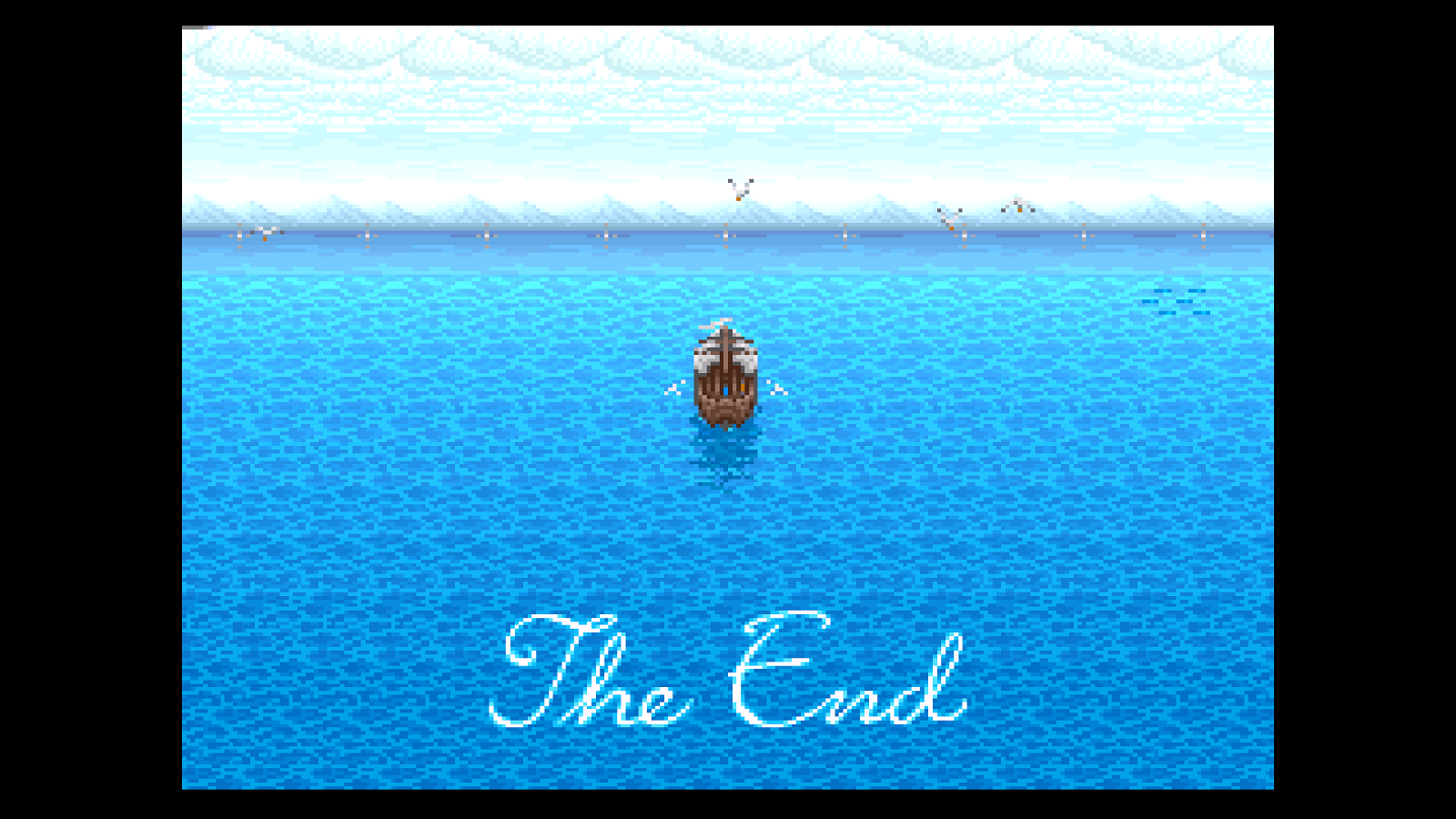
I win again again
---- ---- ---- ----

Whew! This article had been sitting around unfinished for a while! In the meantime, I tried to get a little further in The After Years, but I'm still stuck before a particular encounter with the Mysterious Girl on the moon. At least I get more time to play as Golbez! And I started into VI and Crisis Core.

But enough rambling, I'm off to play that free demo of Final Fantasy XV!

Friday, March 4, 2016

Final Fantasy Quest - The Search for Silly

It's hard to believe the amount of expressions that can be expressed in 16-bit form.

Until you play Final Fantasy V (FFV) for the first time.

Long story short, my favorite aspect of FFV are the characters. Coming off the heels of the played-straight serious FFIV, the zany hijinks of Bartz and crew are a nice change. Yes, sad stuff happens in the game, but the overall tone is more light-hearted. This game is the birthplace of Final Fantasy's best recurring character, Gilgamesh. (Also, heavy spoilers to follow after these lovely pictures).

Haha! It's not like I wanted you to show up, or anything...

*gasp!* The fiend!?!

If you're familiar with this game, what I say next will be no surprise. The job system is pretty rad. A dramatic improvement over the system in FFIII (more on that in a future article, hopefully) the job system in FFV allows a player to assign characters to whatever jobs they want. Skills mastered can be added to other jobs, so you can have a white mage that can brawl, or a monk that can heal everyone. Plus, once a job is fully mastered, it passes abilities on to the "Normal" class that you began as.

However, the best part about the job system is this:

Pirate ninja princess.

I'll say it again: pirate ninja princess. The pirate captain Faris, who is the best and most badass character in the party, can be a ninja too.

Plus, Square did the "pirate captain who is secretly a princess" thing a good ten years before Nintendo's The Legend of Zelda: The Wind Waker.

Not such hot stuff anymore, huh!?

Story-wise, the game is somewhat predictable. The main focus, again, is trying to keep the four elemental crystals intact (and failing miserably). As I said above, the characters are the best part of FFV; namely, how they interact and react to people and events. They may be simple 16-bit sprite, but they are able to express a wide array of emotions.

What even is that pose, Faris?

There are even a number of optional spells and espers, like a few of the Bard's songs, some blue magic and the summons Shiva or Carbuncle. And unlike a few of FFIV's harder-to-get summons, these ones are actually worth finding.

Overall, this is one of the better entries in the series, and it is definitely a viable entry point for newcomers to the series. Even with the myriad of jobs, it is manageable to keep your party powerful, as all playable characters remain in the party, and which jobs you master depends on your particular play-style.

In the Faris screenshot, you could see that I had mastered all the jobs (barring Mime class). This is not a task I would advise someone to do, as it took hours of grinding to accomplish.

Anyway, I'm close to finishing it, having made a good bit of progress in World 3 (out of 3). Apologies for not getting to The After Years, I got stuck and put it aside for a bit. Because I know I love FFVI, I might pause before moving on to that entry.

Until next time, later guys!

Wednesday, March 2, 2016

Math - My Journey with Choose

In light of recent stormy/controversial political events, why not take a break with something that everyone loves? (Or hates, but how could you possibly hate it?)

Math!

Yes, math. Ever since undergrad, I'd always fancied myself something of a math enthusiast. I don't understand half the stuff, but it's endless fascinating.

Lately, I've been going at a random college textbook I have. College Algebra and Trigonometry (from 1984 no less!) has a nice spread of concepts, including the mystifying sigma notation and the methods for doing matrix operations. Important today, however, is an equation found on the inside cover:

AKA binomial equation, or binomial formula

My interest was piqued when a math channel, associated with my favorite math(s) channel, Numberphile, did a video on the "choose function," which used the above equation to figure out the number of ways objects in a subgroup could be arranged in the overall group.

That same mathematician talked about how spreadsheets could be great fun, so I decided to combine the ideas. Doodling various combinations of 7 choose 2, or 7 choose 5, I saw that some results were the same. For instance, there are 7 ways to choose 1 object in 7 objects, and there is the same number of ways to choose 6 objects in the same group of 7.

Confused? It'll be cleared up soon, don't worry.

Figuring out a general equation proved to be too difficult/require too much effort, so I leaved off doing that. However, observing that the numbers increased and decreased in a steady manner, I did the only logical thing: I made a bar graph from the data. Witness the beauty below:

Extra large for your viewing pleasure
If you do any work with statistics at all, you'll recognized this as the normal distribution. I could go on about how the choose function is related to binomial coefficients and Pascal's triangle, but that would be excessive and redundant, since they're all so closely related.

With my limited skills in mathematics, being able to put things together like this was really fun. For the skilled mathematician, something like this is a given. It is fascinating to be able to take a series of numbers, work some "magic" with them in a spreadsheet, and discover a relation I never knew before.

But I suppose that's the heart of math, then? Using the tools to discover new and cool things?

Anyway, I'll close before I ramble on too long.

Tuesday, February 9, 2016

Literature - "Suspension of Disbelief" is a Stupid Term

Very often, when one speaks of literature or writing - especially creative writing - the term "suspension of disbelief" or "willing suspension of disbelief" is wont to come up. In a fictional story, we are told, one must suspend his or her disbelief and enter the world of the narrative. The term is stupid and you shouldn't use it.

End of article.

...

Just kidding! The term is still stupid, but there is an excellent alternative, posited by the illustrious JRR Tolkien, no less! In his paper, "On Fairy Stories," Tolkien goes through an in-depth discussion of what Faerie is, what fairies are and are not, and various other topics related to the genre. Important for us are his thoughts on story-crafting in general.

"The moment disbelief aries, the spell is broken; the magic, or rather art, has failed. You are then out in the Primary World again, looking at the little abortive Secondary World from outside," Tolkien notes.

Rather than staying immersed in the narrative, you are ejected to the "real world." As Tolkien stated earlier in the paper, good writers are able to evoke "literary belief" in the reader. Only by becoming what Tolkien has termed a "sub creator" can an artist truly create a world to which a reader can ascribe any appreciable level of "Secondary Belief."

For instance, the sign of a good movie is being able to walk out of the theatre, discussing the movie in the terms and lingo of the characters themselves - and giving no thoughts such as "Well, this is a fictive universe, but..." Because the script writer did his or her job well, the viewer is not forced to consider the poor writing and be drawn out of the secondary world.

The idea of secondary belief is especially important to the genre of fantasy. As opposed to the "realistic" literature of the recent century, fantasy literature seeks to create a whole world of its own. Or, as in the case of Star Wars, an entire galaxy of its own. Walking out of the most recent Star Wars movie, my first thoughts were not "Who wrote that," but were decidedly more story based. In-universe, secondary belief type thoughts and conversations (I had gone with family) were the focus that day.

To truly enjoy literature, one must throw away the idea of merely accepting the "inaccuracies" of a fictional world. Instead, by holding a secondary belief, the literature, movie or TV show become alive for us.

----
Work cited: "On Fairy Stories," by JRR Tolkien

Wednesday, February 3, 2016

Gaming Chronicles - The Final Fantasy Quest

(Please note, there will be heavy spoilers for Final Fantasy IV [and a bit for VI] ahead. I know it's 20+ years old, but I just wanted to be courteous!)

One reason I got into composing and music in general is because of the tuneful work of Nobuo Uematsu. Additionally, Square is even now working on the Final Fantasy VII remake and Final Fantasy XV. What better time to begin a play through of the whole main series? It'd be a fun quest, I thought.

Rather than begin at the beginning, like most would, I began with the fourth entry in the series, Final Fantasy IV. (And it was partly inspired by the GDQ speed run of it at the recent GDQ.)

AKA Final Fantasy IV

I had attempted the game before, on my old Toshiba laptop, but had only gotten so far before quitting for some reason (it was college, so it might have been finals, leaving for the summer, etc...). I had played through 90% of Final Fantasy VI, so who knows.

Released in 1991, FFIV was the earliest Final Fantasy to give the characters ... well, actual character. In prior entries, the playable people were merely blank slates for the player to choose and name at will. However, in FFIV, each character has a defined identity, such as Dark Knight Cecil or his girlfriend Rosa. There's even a spoony bard!

Am I?

One of the things that I liked the most about FFIV is the character arc of Cecil, the main character. In the beginning, he is the Dark Knight, and does the dirty deeds of the Baron Kingdom. Well, we only see one, namely, the theft of the water crystal. Despite this, a few members of the Red Wings (the air force of Baron) object to the deed they had just done. Eventually, Cecil questions the king himself.

An interesting side note: in the original Japanese release, Cecil had a powerful attack called "Dark" or "Dar Wave" that damaged opponents at the cost of some HP. Although removed in the English release, it points to development in his character. As a Dark Knight, his ability is to take damage in order to harm others. Once he became a Paladin, however, his special ability is "Cover," which sacrifices HP to protect another from harm.

However, Cecil's redemption story arc is a bit shorter than it could have been. Even with the unintentional destruction of Mist, most of his arc is completed fairly early in the game. (Or, it felt early on to me.) Without getting too far ahead of myself, I'd just comment that Final Fantasy VI does a bit better job dealing with a lead character struggling with identity. (Both Cecil and Terra are half-human, half something else. Both initially death with being manipulated by a villainous force. Etc...)

What is this HR Giger doing in my Final Fantasy?

Overall, I had a nice time with the game. There were a few annoyances, though. For one, the encounter rate felt really high at times - especially in certain caves. The overall party was a mixed bag. It was cool to be able to use all sorts of characters, but a lot of them dropped out of the party, seemingly without warning. At least it wasn't Final Fantasy II in THAT regard, amiright?

This place was the WORST

For me, I had to do a bit of grinding in the later phases of the game. I didn't manage to acquire all the top weapons (in the final dungeon) but I did get all the major summons and most of the top-tier weapons. Overall, it's a pretty good game, but not a Final Fantasy title I'd start off with.

Tune in next time (hopefully) for a look at Final Fantasy IV: The After Years, an episodic sequel to this game released on mobile platforms.

I win!!

Thursday, January 28, 2016

Gaming - Gotta Go Fast!

For the longest time, I completely ignored videos that were primarily watching other people play video games (so called "let's plays" to be exact.) However, during my senior year at college, I was a little bit more charitable. One of my favorite channels (The Completionist) was affiliated with its own LP channel. I discovered that (good) LPs were more than JUST gameplay, but commentary and incidental humour.

Then I discovered GDQ.

I'm sure I hadn't heard of speed-running up to that point, but it was probably for the best. Anytime a GDQ is going on, my sleep schedule is completely wrecked. But I'm getting ahead of myself! GDQ, or Games Done Quick, is a charity marathon run twice a year. Just a few days [weeks now] before this article went up, the winter GDQ, Awesome Games Done Quick, just wrapped up. (Mercifully, they finished around 3:00 AM this time.)

Particularly, I enjoy GDQ for commentary and glitches. If a game is large in scope, chances are there are some wonderful glitches allowing large portions of it to be skipped. For instance, the Legend of Zelda: A Link to the Past can be completed in mere minutes by the use of a out-of-bounds glitch. On longer runs, I enjoy when the runner, or the group on the couch behind him or her, provide amusing and insightful information on the game at hand.


(I dunno why, but this was one of my favorite runs this year's AGDQ.) Plus, the charities they do the marathon for are good causes. This recent GDQ ran for the Prevent Cancer Foundation.

Speedruns can be beautiful, such as Super Mario 64 runs - specifically, the poetry of motion that occurs in any of the Bowser levels. Anything with good controls can lead to masterful exhibitions of dexterity and finesse. But enough talk.

Here is the current WR for Super Mario 64 0-star (as indexed on speedrun.com):


Stuff like that is probably why Super Mario 64 is at GDQ so often.

Anyway, that's just a few thoughts on speedrunning and what not. Thanks for reading.