Very often, when one speaks of literature or writing - especially creative writing - the term "suspension of disbelief" or "willing suspension of disbelief" is wont to come up. In a fictional story, we are told, one must suspend his or her disbelief and enter the world of the narrative. The term is stupid and you shouldn't use it.
End of article.
...
Just kidding! The term is still stupid, but there is an excellent alternative, posited by the illustrious JRR Tolkien, no less! In his paper, "On Fairy Stories," Tolkien goes through an in-depth discussion of what Faerie is, what fairies are and are not, and various other topics related to the genre. Important for us are his thoughts on story-crafting in general.
"The moment disbelief aries, the spell is broken; the magic, or rather art, has failed. You are then out in the Primary World again, looking at the little abortive Secondary World from outside," Tolkien notes.
Rather than staying immersed in the narrative, you are ejected to the "real world." As Tolkien stated earlier in the paper, good writers are able to evoke "literary belief" in the reader. Only by becoming what Tolkien has termed a "sub creator" can an artist truly create a world to which a reader can ascribe any appreciable level of "Secondary Belief."
For instance, the sign of a good movie is being able to walk out of the theatre, discussing the movie in the terms and lingo of the characters themselves - and giving no thoughts such as "Well, this is a fictive universe, but..." Because the script writer did his or her job well, the viewer is not forced to consider the poor writing and be drawn out of the secondary world.
The idea of secondary belief is especially important to the genre of fantasy. As opposed to the "realistic" literature of the recent century, fantasy literature seeks to create a whole world of its own. Or, as in the case of Star Wars, an entire galaxy of its own. Walking out of the most recent Star Wars movie, my first thoughts were not "Who wrote that," but were decidedly more story based. In-universe, secondary belief type thoughts and conversations (I had gone with family) were the focus that day.
To truly enjoy literature, one must throw away the idea of merely accepting the "inaccuracies" of a fictional world. Instead, by holding a secondary belief, the literature, movie or TV show become alive for us.
----
Work cited: "On Fairy Stories," by JRR Tolkien
Tuesday, February 9, 2016

Wednesday, February 3, 2016
Gaming Chronicles - The Final Fantasy Quest
(Please note, there will be heavy spoilers for Final Fantasy IV [and a bit for VI] ahead. I know it's 20+ years old, but I just wanted to be courteous!)
One reason I got into composing and music in general is because of the tuneful work of Nobuo Uematsu. Additionally, Square is even now working on the Final Fantasy VII remake and Final Fantasy XV. What better time to begin a play through of the whole main series? It'd be a fun quest, I thought.
Rather than begin at the beginning, like most would, I began with the fourth entry in the series, Final Fantasy IV. (And it was partly inspired by the GDQ speed run of it at the recent GDQ.)
I had attempted the game before, on my old Toshiba laptop, but had only gotten so far before quitting for some reason (it was college, so it might have been finals, leaving for the summer, etc...). I had played through 90% of Final Fantasy VI, so who knows.
Released in 1991, FFIV was the earliest Final Fantasy to give the characters ... well, actual character. In prior entries, the playable people were merely blank slates for the player to choose and name at will. However, in FFIV, each character has a defined identity, such as Dark Knight Cecil or his girlfriend Rosa. There's even a spoony bard!
One of the things that I liked the most about FFIV is the character arc of Cecil, the main character. In the beginning, he is the Dark Knight, and does the dirty deeds of the Baron Kingdom. Well, we only see one, namely, the theft of the water crystal. Despite this, a few members of the Red Wings (the air force of Baron) object to the deed they had just done. Eventually, Cecil questions the king himself.
An interesting side note: in the original Japanese release, Cecil had a powerful attack called "Dark" or "Dar Wave" that damaged opponents at the cost of some HP. Although removed in the English release, it points to development in his character. As a Dark Knight, his ability is to take damage in order to harm others. Once he became a Paladin, however, his special ability is "Cover," which sacrifices HP to protect another from harm.
However, Cecil's redemption story arc is a bit shorter than it could have been. Even with the unintentional destruction of Mist, most of his arc is completed fairly early in the game. (Or, it felt early on to me.) Without getting too far ahead of myself, I'd just comment that Final Fantasy VI does a bit better job dealing with a lead character struggling with identity. (Both Cecil and Terra are half-human, half something else. Both initially death with being manipulated by a villainous force. Etc...)
Overall, I had a nice time with the game. There were a few annoyances, though. For one, the encounter rate felt really high at times - especially in certain caves. The overall party was a mixed bag. It was cool to be able to use all sorts of characters, but a lot of them dropped out of the party, seemingly without warning. At least it wasn't Final Fantasy II in THAT regard, amiright?
For me, I had to do a bit of grinding in the later phases of the game. I didn't manage to acquire all the top weapons (in the final dungeon) but I did get all the major summons and most of the top-tier weapons. Overall, it's a pretty good game, but not a Final Fantasy title I'd start off with.
Tune in next time (hopefully) for a look at Final Fantasy IV: The After Years, an episodic sequel to this game released on mobile platforms.
One reason I got into composing and music in general is because of the tuneful work of Nobuo Uematsu. Additionally, Square is even now working on the Final Fantasy VII remake and Final Fantasy XV. What better time to begin a play through of the whole main series? It'd be a fun quest, I thought.
Rather than begin at the beginning, like most would, I began with the fourth entry in the series, Final Fantasy IV. (And it was partly inspired by the GDQ speed run of it at the recent GDQ.)
 |
| AKA Final Fantasy IV |
I had attempted the game before, on my old Toshiba laptop, but had only gotten so far before quitting for some reason (it was college, so it might have been finals, leaving for the summer, etc...). I had played through 90% of Final Fantasy VI, so who knows.
Released in 1991, FFIV was the earliest Final Fantasy to give the characters ... well, actual character. In prior entries, the playable people were merely blank slates for the player to choose and name at will. However, in FFIV, each character has a defined identity, such as Dark Knight Cecil or his girlfriend Rosa. There's even a spoony bard!
 |
| Am I? |
One of the things that I liked the most about FFIV is the character arc of Cecil, the main character. In the beginning, he is the Dark Knight, and does the dirty deeds of the Baron Kingdom. Well, we only see one, namely, the theft of the water crystal. Despite this, a few members of the Red Wings (the air force of Baron) object to the deed they had just done. Eventually, Cecil questions the king himself.
An interesting side note: in the original Japanese release, Cecil had a powerful attack called "Dark" or "Dar Wave" that damaged opponents at the cost of some HP. Although removed in the English release, it points to development in his character. As a Dark Knight, his ability is to take damage in order to harm others. Once he became a Paladin, however, his special ability is "Cover," which sacrifices HP to protect another from harm.
However, Cecil's redemption story arc is a bit shorter than it could have been. Even with the unintentional destruction of Mist, most of his arc is completed fairly early in the game. (Or, it felt early on to me.) Without getting too far ahead of myself, I'd just comment that Final Fantasy VI does a bit better job dealing with a lead character struggling with identity. (Both Cecil and Terra are half-human, half something else. Both initially death with being manipulated by a villainous force. Etc...)
 |
| What is this HR Giger doing in my Final Fantasy? |
Overall, I had a nice time with the game. There were a few annoyances, though. For one, the encounter rate felt really high at times - especially in certain caves. The overall party was a mixed bag. It was cool to be able to use all sorts of characters, but a lot of them dropped out of the party, seemingly without warning. At least it wasn't Final Fantasy II in THAT regard, amiright?
 |
| This place was the WORST |
For me, I had to do a bit of grinding in the later phases of the game. I didn't manage to acquire all the top weapons (in the final dungeon) but I did get all the major summons and most of the top-tier weapons. Overall, it's a pretty good game, but not a Final Fantasy title I'd start off with.
Tune in next time (hopefully) for a look at Final Fantasy IV: The After Years, an episodic sequel to this game released on mobile platforms.
 |
| I win!! |
Thursday, January 28, 2016
Gaming - Gotta Go Fast!
For the longest time, I completely ignored videos that were primarily watching other people play video games (so called "let's plays" to be exact.) However, during my senior year at college, I was a little bit more charitable. One of my favorite channels (The Completionist) was affiliated with its own LP channel. I discovered that (good) LPs were more than JUST gameplay, but commentary and incidental humour.
Then I discovered GDQ.
I'm sure I hadn't heard of speed-running up to that point, but it was probably for the best. Anytime a GDQ is going on, my sleep schedule is completely wrecked. But I'm getting ahead of myself! GDQ, or Games Done Quick, is a charity marathon run twice a year. Just a few days [weeks now] before this article went up, the winter GDQ, Awesome Games Done Quick, just wrapped up. (Mercifully, they finished around 3:00 AM this time.)
Particularly, I enjoy GDQ for commentary and glitches. If a game is large in scope, chances are there are some wonderful glitches allowing large portions of it to be skipped. For instance, the Legend of Zelda: A Link to the Past can be completed in mere minutes by the use of a out-of-bounds glitch. On longer runs, I enjoy when the runner, or the group on the couch behind him or her, provide amusing and insightful information on the game at hand.
(I dunno why, but this was one of my favorite runs this year's AGDQ.) Plus, the charities they do the marathon for are good causes. This recent GDQ ran for the Prevent Cancer Foundation.
Speedruns can be beautiful, such as Super Mario 64 runs - specifically, the poetry of motion that occurs in any of the Bowser levels. Anything with good controls can lead to masterful exhibitions of dexterity and finesse. But enough talk.
Here is the current WR for Super Mario 64 0-star (as indexed on speedrun.com):
Stuff like that is probably why Super Mario 64 is at GDQ so often.
Anyway, that's just a few thoughts on speedrunning and what not. Thanks for reading.
Wednesday, November 25, 2015
Tuesday, November 24, 2015
Album - Adventures in Undertale
I recently played through the indie RPG, Undertale. It was a pretty good time, and I would recommend the game to anyone who's a fan of good things. This is an album with screenshots showing silly stuff and stuff that I just plain liked. Spoilers are abounding, so beware.
View post on imgur.com
Friday, October 2, 2015
Music - More Than Just Ink
Music's great, right? Beautiful sounds, dramatic sounds, discordant sounds - and even the silences. Civilization has done music since the very beginning.
Now that technology has progressed, music is available to hear and to study. I am very grateful for the neat, transcribed scores of Beethoven's symphonies, at my university, that I could peruse whilst listening to a sound recording of the very works. In the music theory classes I took, we examined a number of pieces, both on the sheet, and via the piano skills of the professor. Especially helpful were piano and voice lessons, that forced me to study and learn the pieces in far greater detail than a mere aural audit of them.
What prompted this ramble about music and a small trip down College Nostalgia Ln? I was looking at my brother's music appreciation textbook. A composition of Charles Ives in particular. "Country Band March" is full of quotes from other famous works and composers, such as Sousa's "Semper Fidelis" and folk songs of Ives' childhood. All western pieces.
And, most music theory and history classes focus primarily on western music. Classical music was created by western composers, and a good deal of popular music is dominated by western artists. The great music of legendary composers was able to be passed down due to the innovation of sheet music. As Europe perfected musical notation, composers rose to prominence. Even as far as the 20th century, sheet music was the primary way listeners were able to experience some of history's greatest gems.
In short, western music and its notation are virtually inseparable. A fact that shows its greatest strength, and greatest weakness.
What do I mean by that?
In giving us the means to preserve music, sheet music can misdirect or even redefine what music people see as music. One might grab a collection of piano pieces and think, "This is difficult music. I wonder if I'll ever be able to play it?" In this case, music is seen as the ink on the page. The quarter notes and rest marks. However, music is far more than this.
In early Christianity, the church did not refer to a building, but rather, the body of faithful. Prior to the written word, literature was the stories passed down from generation to generation. As with these cases, music should not, and cannot, be viewed as merely lines and dots in books, or a physical object.
Other art forms can, and should, be appreciated for their physicality. The works of Michelangelo or Van Gogh are best seen on canvas, or pedestal, as the case may be. Music, though, can only truly be enjoyed through the hearing. The listening.
Don't let sheet music fool you. There's more to music than meets the eye.
Now that technology has progressed, music is available to hear and to study. I am very grateful for the neat, transcribed scores of Beethoven's symphonies, at my university, that I could peruse whilst listening to a sound recording of the very works. In the music theory classes I took, we examined a number of pieces, both on the sheet, and via the piano skills of the professor. Especially helpful were piano and voice lessons, that forced me to study and learn the pieces in far greater detail than a mere aural audit of them.
What prompted this ramble about music and a small trip down College Nostalgia Ln? I was looking at my brother's music appreciation textbook. A composition of Charles Ives in particular. "Country Band March" is full of quotes from other famous works and composers, such as Sousa's "Semper Fidelis" and folk songs of Ives' childhood. All western pieces.
And, most music theory and history classes focus primarily on western music. Classical music was created by western composers, and a good deal of popular music is dominated by western artists. The great music of legendary composers was able to be passed down due to the innovation of sheet music. As Europe perfected musical notation, composers rose to prominence. Even as far as the 20th century, sheet music was the primary way listeners were able to experience some of history's greatest gems.
In short, western music and its notation are virtually inseparable. A fact that shows its greatest strength, and greatest weakness.
What do I mean by that?
In giving us the means to preserve music, sheet music can misdirect or even redefine what music people see as music. One might grab a collection of piano pieces and think, "This is difficult music. I wonder if I'll ever be able to play it?" In this case, music is seen as the ink on the page. The quarter notes and rest marks. However, music is far more than this.
In early Christianity, the church did not refer to a building, but rather, the body of faithful. Prior to the written word, literature was the stories passed down from generation to generation. As with these cases, music should not, and cannot, be viewed as merely lines and dots in books, or a physical object.
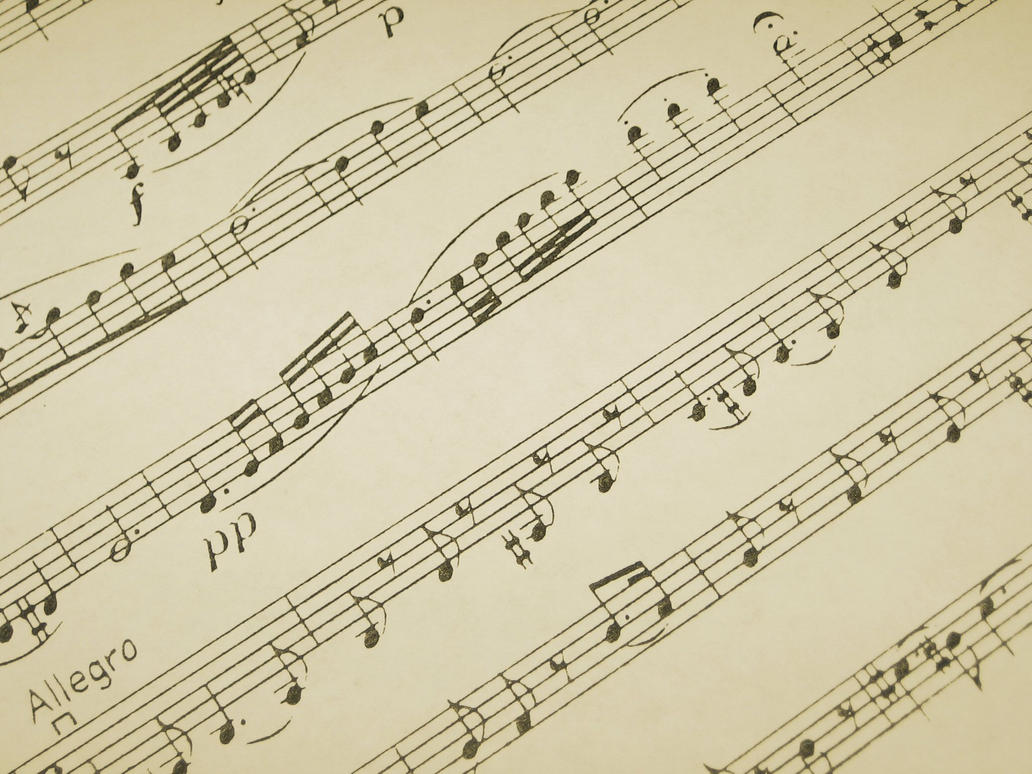 |
| This is not music |
Don't let sheet music fool you. There's more to music than meets the eye.
Friday, August 7, 2015
MGS V - Some Thoughts on a Letter, Some Thoughts on a Number
Recently (as in the last few months) I've been getting into the lore of another fandom. Namely, that of Metal Gear Solid. I remember seeing a physical copy of the first game at my house years ago, but never got to play it because it was rated "M." Fast forward to a many years later, and I've already read up on the story and lore, and just break down and buy it as a PS One Classic.
Now the hype is increasing as the release of Metal Gear Solid V: Phantom Pain draws near. I've just finished the 3rd game and started the 4th. Then Jamez took over and started into 4 also. And gotten further than me. ARGRH.
Anyway, the poster of Phantom Pain got me thinking.
Now the hype is increasing as the release of Metal Gear Solid V: Phantom Pain draws near. I've just finished the 3rd game and started the 4th. Then Jamez took over and started into 4 also. And gotten further than me. ARGRH.
Anyway, the poster of Phantom Pain got me thinking.
 |
| Almost a !. So close, yet so far |
The letter V, I'm sure, was chosen because it's seen as "classier" than a plain old 5. Maybe to avoid the appearance of churning out so many games. (Probably not. Anyway, if there were a 6th, I'd hope it'd be Metal Gear Solid 6, since Roman numerals can be pretty awkward to deal with in certain numbers.)
V has several meanings, though. As a music major, I immediately think of a famous V - Beethoven's Fifth Symphony. It has the famous (or infamous, depending on who you ask) musical figure of three short notes followed by a long one:
 |
| Dun dun dun DUUUUH, dun dun dun DUUUUH |
While looking up morse code to try to "decipher" part of a trailer (there wasn't anything there, at least not that I could find) I saw another interesting connection: the pattern short-short-short-long, present in the Fifth Symphony, was also the morse code for the letter "V."
That's all fine and dandy, you say. V = ..._ = Fifth Symphony. Big deal.
However, let's take a closer look at the motif and symphony itself. First of all, Fifth Symphony is considered to be one of Beethoven's greatest works. Ground Zeroes and Phantom Pain have the potential to be Kojima's Fifth Symphony.
The main motif of Beethoven's work is usually seen as signifying "fate," by most listeners in the public. GZ and PP are the chapters which will most likely conclude Big Boss's saga by showing his ultimate transition from anti-hero to villain. As much as we may feel for his loss at the end of Ground Zeroes, Big Boss ultimately sets in motion the development of several world-endangering Metal Gear projects, among other things. Ultimately, his fate is sealed. Yet, like the different moods within the Fifth Symphony, there is opportunity for some hope within BB's tragic tale.
The key of C minor represents a heroic struggle, much like Big Boss faces.
Anyway, enough romanticizing - the link between the two was tenuous enough.
The V on the poster vaguely resembles the font of the first PS title, and could be seen as either an upside-down "A" or a ! that got into an accident with a letter-opener. I should refrain from reading so much into a single letter, but it is interesting that the "V" does not match the font of the title of the game (Or anything else on the poster, for that matter.)
One last thing I'll say about the V: a common hand-gesture, known as the "V sign" meant at one time "victory," and can now mean that, or "peace." Big Boss suffers a major loss, and this loss was of a base built and manned during a game called "Peace Walker." On the other hand, if the gesture is reversed, it becomes an offensive one. I'm sure that at least one of the MSF felt like flashing at least that at the forces that destroyed Mother Base.
Anyway, I could go on finding thin links between real-life used of V and the V sign, and Metal Gear, but I won't. I could say something like, "V gesture can also be devil horns, and Big Boss is already a demon," but I'll quit now.
Stay hyped!
"V has come to."
Subscribe to:
Posts (Atom)